top of page

Design and Irreducible Complexity?
Michael Behe is a Professor of Biochemistry at Lehigh University. He famously wrote the book
“Darwin’s Black Box.
He coined the term "Irreducible Complexity". Shortly we shall explain what this is, but first, let’s consider what Richard Dawkins the evolutionary advocate had to say about design within biology. Dawkins agrees saying “they look like they were designed but they weren’t designed”. His proof? He doesn’t have any. His reasoning? Well, the theory of evolution doesn’t allow for design so it can’t have been designed. But hang on; the theory the moon is made from cheese doesn’t provide proof the moon is made from cheese either.
The concept of Irreducible Complexity means reducing something to the simplest possible form before it stops working. Behe’s example was the mousetrap but I shall use a push bike as a different example.
The bike in-of-itself is complex, but as we can see it is not good enough to have any old set of wheels. To make a working pushbike, you need the right sort of wheels. The wheel is an irreducible complex sub-system within the bike; to work the wheel has to have a wheel rim. The tyres have to be the right size, the wheel has to have spokes. To assemble the wheel you need the correct number of spokes and these have to be the right length, they need a special hook on one end and a special nut at the other. You get the picture;


We could continue forever looking at each detail of every part. The conclusion is that all the parts have to be designed and have to fit. The maker of bicycle tyres has to work to a specification, if 27” diameter wheels are the standard there is no point making a 27 ½ inch diameter tyre ! A design goes beyond the “wished for” end result and requires specifications and detailed descriptions of every part.
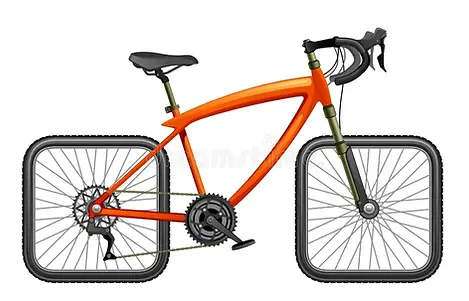
No one would buy a bike with square wheels just because the shop said they hadn’t figured out how to make round ones yet. We all know won't work. _________
__________ and when we look at biological systems, which are far more complex, we discover the same. Every part in our body has to work with the other parts. Every part we examine has subsystems. No one would accept that a tyre factory would come up with the exact tyre required for a racing bike if they did not know in advance what sizes were needed; so why accept that an undirected random evolutionary process can come up with other parts that need exactingly preceise designs as well.
Why buy a theory that doesn’t work*, has missing parts which is without evidence.
* Sold as seen - no warranty offered or implied
bottom of page